Top SEO Mistakes Small Businesses Make When Trying to Rank on Google
Top 5 SEO Mistakes Small Businesses Make When Trying to Rank on Google For small businesses, appearing on the first...
Read More →
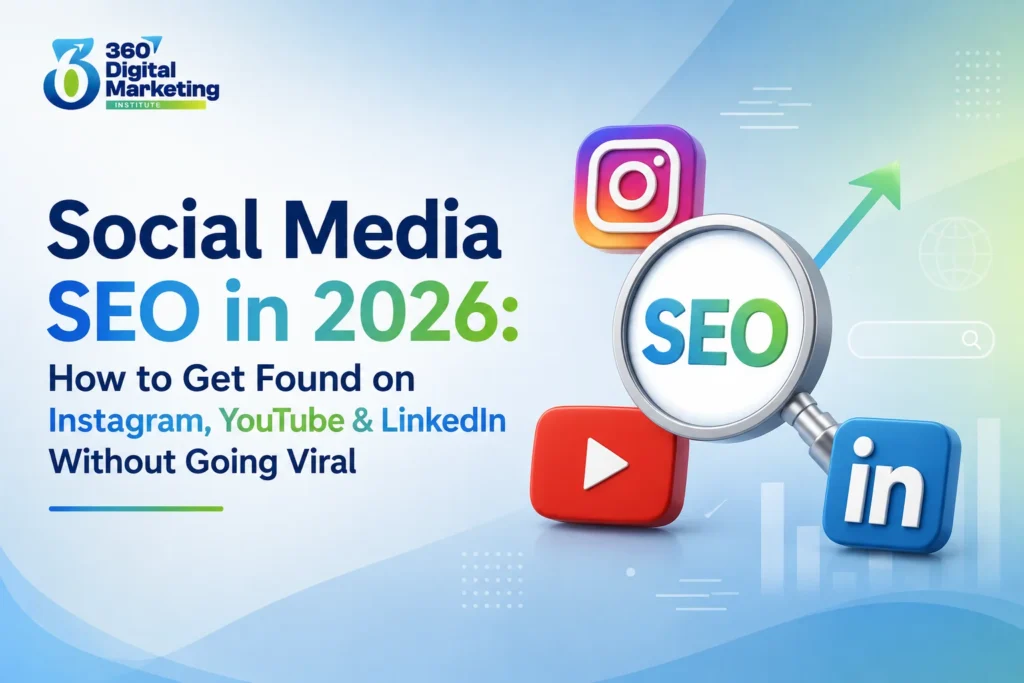
Going viral can bring thousands or even millions of views, but it is not the only way to get discovered on social media. In 2026, people increasingly use platforms such as Instagram, YouTube, and LinkedIn to search for information, discover businesses, find creators, learn new skills, and research products and services.
This is where social media SEO becomes important.
Instead of creating content and simply hoping that an algorithm recommends it, social media SEO focuses on making your content easier for both users and platform search systems to understand and discover.
The goal is not necessarily to get millions of views. The goal is to get found by the right audience.
Social media SEO is the process of optimizing your social media profiles and content so they have a better chance of appearing when people search within social platforms.
It includes activities such as:
Traditional SEO focuses heavily on search engines such as Google, while social media SEO focuses on discovery within platforms such as Instagram, YouTube, and LinkedIn.
The principles are different, but one idea remains the same:
Make it easy for the platform and the user to understand what your content is about.
Social media is no longer used only for entertainment and networking.
Users are increasingly searching directly on platforms for tutorials, reviews, recommendations, educational content, professionals, businesses, and solutions to specific problems.
For example, someone looking for SEO advice might search for:
If your content clearly addresses these topics, it has an opportunity to be discovered through search even if your account does not have a massive following.
This makes search optimization particularly useful for small businesses, professionals, educators, creators, and personal brands.
Instagram has evolved beyond a platform where users simply scroll through photos and videos. Search and discovery play an important role in how people find accounts and content.
1. Optimize Your Instagram Profile
Your profile should clearly communicate what you do.
Your name field, username, bio, and category can help establish relevance.
For example, if you provide digital marketing training, your profile should make that clear instead of using only a brand slogan.
Use relevant terms naturally in your profile so users immediately understand your expertise.
2. Use Keywords in Captions
Instagram captions should not be written only for engagement.
Include the primary topic or keyword naturally in the caption.
Instead of writing a vague caption such as:
“Want better results? Try this!”
A more descriptive caption could explain exactly what the content covers:
“Here are five Instagram SEO tips to help businesses improve their content discoverability.”
The second version gives both users and search systems stronger context.
3. Create Search-Friendly Content
Think about what your audience is actually searching for.
Content ideas could include:
Answering specific questions can help your content remain discoverable beyond its initial publication.
4. Use Relevant Hashtags
Hashtags can still provide additional context and discovery opportunities when used appropriately.
Rather than adding a large collection of unrelated hashtags, use a smaller set that accurately describes the topic, industry, audience, or location.
The focus should be relevance over quantity.
YouTube is one of the strongest examples of social media functioning as a search engine.
People actively search YouTube for tutorials, reviews, explanations, demonstrations, courses, and solutions.
That makes YouTube SEO essential for creators and businesses that want long-term content discovery.
1. Research Search Intent
Before creating a video, understand what your audience wants to find.
For example:
The closer your content matches the actual search intent, the more useful it can be to viewers.
2. Write Descriptive Video Titles
Your video title should clearly communicate what the viewer will learn.
Instead of:
“You Won’t Believe This SEO Trick!”
Consider:
“SEO for Beginners: 10 Practical SEO Tips to Improve Your Website”
The second title is more descriptive and gives YouTube and users clearer information about the video’s subject.
3. Optimize Video Descriptions
Use the description to explain what the video covers.
Include relevant terms naturally, summarize important sections, and provide useful information about the content.
Avoid filling descriptions with repetitive keywords. The objective is to improve clarity, not manipulate search.
4. Use Relevant Video Chapters
For longer videos, chapters can help viewers navigate specific sections.
They also make the content easier to understand because viewers can quickly identify the topics covered in the video.
5. Focus on Viewer Satisfaction
SEO can help people discover a video, but the quality of the video determines whether they continue watching.
Strong YouTube content should focus on:
The objective is not simply to attract a click. It is to create content worth watching.
LinkedIn is increasingly important for professional discovery.
People use it to find companies, professionals, recruiters, industry experts, services, educational content, and career opportunities.
This makes LinkedIn SEO particularly valuable for professionals and businesses.
1. Optimize Your LinkedIn Profile
Your headline should clearly explain what you do and who you help.
For example, instead of a generic headline such as:
Digital Marketer | Entrepreneur
A more descriptive version could be:
Digital Marketing Trainer | SEO & Performance Marketing | Helping Businesses Grow Online
The second headline provides stronger context around your expertise.
2. Use Relevant Keywords Naturally
Include relevant industry terms throughout your profile where appropriate.
These could include:
However, avoid forcing keywords into every section. Your profile should still sound natural and professional.
3. Create Topic-Focused Posts
If you want to build authority around a particular subject, consistently publish content around that topic.
For example, a digital marketing professional could create posts about:
Consistent topical content can help establish what you are known for.
4. Write Searchable Post Content
Instead of beginning every post with a generic statement, make the topic clear.
For example:
“5 Local SEO mistakes small businesses should avoid”
immediately communicates the subject of the post.
This is more useful than a vague opening such as:
“Most businesses are making this mistake…”
You can still use a strong hook while clearly communicating the topic.
Going viral and getting discovered through search are two different strategies.
| Viral Content | Social Media SEO |
|---|---|
| Can generate rapid exposure | Focuses on discoverability |
| Often driven by trends | Often driven by search intent |
| May have a short lifespan | Can generate longer-term discovery |
| Requires strong distribution | Relies on relevance and optimization |
| Can reach a broad audience | Can attract a more specific audience |
Neither approach is necessarily better in every situation.
However, businesses should not build their entire social media strategy around going viral.
A post that receives 20,000 views from the right audience can sometimes be more valuable than a post that receives 500,000 views from people who have no interest in the business.
A practical social media SEO strategy can follow a simple process.
Step 1: Identify Your Target Audience
Understand who you want to reach.
Ask:
Step 2: Find Relevant Search Topics
Research the phrases and questions your audience uses.
These topics can become:
Step 3: Create Content Around Search Intent
Don’t create content simply because a keyword has search volume.
Make sure the content actually answers the question or solves the problem behind the search.
Step 4: Optimize the Content
Use relevant keywords naturally in:
Step 5: Build Topical Authority
Don’t publish one post about a subject and move on.
Create multiple pieces of useful content around related topics.
For example, someone focusing on SEO could create content about:
SEO basics → Keyword research → On-page SEO → Technical SEO → Local SEO → Link building → SEO analytics
This creates a stronger topical content ecosystem.
Step 6: Analyze and Improve
Monitor which topics generate:
Then create more content around the subjects that consistently attract the right audience.
One of the biggest advantages of social media SEO is that it can help content remain discoverable after the initial publishing period.
A useful YouTube tutorial can continue attracting viewers months later.
An Instagram post answering a specific question can appear when someone searches for that topic.
A LinkedIn post explaining an industry problem can help establish professional expertise.
This is why social media content should not always be treated as disposable. Think of each piece of content as an asset that can continue attracting the right audience over time.
Social media SEO is becoming an important skill for modern digital marketers because social platforms are increasingly becoming discovery and search environments. If you’re considering a digital marketing course in Panvel, look for a program that teaches social media marketing alongside SEO, content strategy, analytics, paid advertising, and other digital marketing skills.
Understanding how users discover content across Google, Instagram, YouTube, LinkedIn, and other platforms can help you develop a more complete digital marketing strategy. Practical training is particularly valuable because social media SEO is best understood by actually researching topics, creating content, optimizing profiles, and analyzing performance.
You do not need to go viral to get discovered on social media.
In 2026, businesses and professionals can use social media SEO to improve their visibility across platforms such as Instagram, YouTube, and LinkedIn.
Instagram SEO focuses on making profiles and content easier to discover through relevant searches and recommendations. YouTube SEO helps videos match search intent and remain discoverable over time. LinkedIn SEO can help professionals and businesses strengthen their visibility around specific skills, industries, and topics.
The most effective strategy is not to chase views for the sake of views.
Instead, understand what your audience is searching for, create genuinely useful content, optimize it for discovery, and consistently build authority around relevant topics.
If you’re learning digital marketing today, social media SEO is a valuable skill to add to your toolkit because the future of social media is not just about being seen—it is about being found by the right people.

360 Digital Marketing Institute is a leading Digital Marketing Institute in Kharghar, offering practical training in SEO, Google Ads, Social Media Marketing, AI Marketing, WordPress, Graphic Design, UI/UX Design, and Amazon eCommerce. Learn through live projects, industry certifications, and placement assistance.
© 2026 | 360 Digital Marketing Institute. | All Rights Reserved
Serving students from Kharghar, Panvel, Kamothe, Kalamboli, Belapur, Nerul, Vashi, Thane, Dombivli, Kalyan, Mulund, Ghatkopar, Kurla, Dadar, and nearby locations across Mumbai and Navi Mumbai.