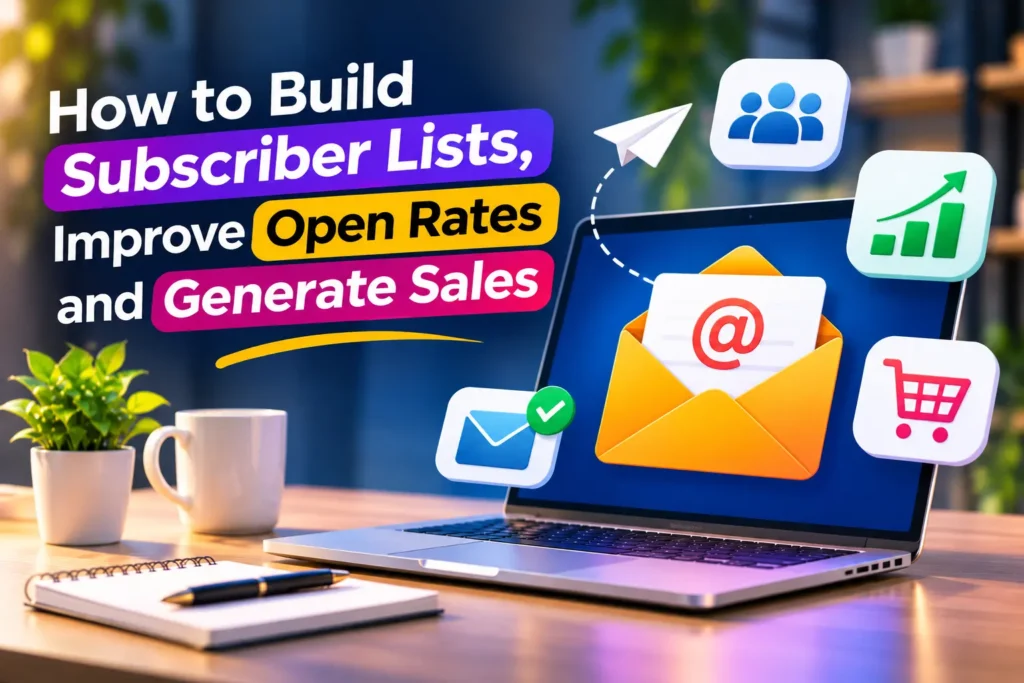
How to Build Subscriber Lists, Improve Open Rates and Generate Sales
How to Build Subscriber Lists, Improve Open Rates and Generate Sales Email marketing remains an important part of digital marketing...
Read More →
Email marketing remains an important part of digital marketing because it allows businesses to communicate directly with people who have shown interest in their products, services or content. While social media platforms help brands reach audiences and search engines attract website visitors, email marketing gives businesses an opportunity to build ongoing relationships with subscribers.
However, successful email marketing requires more than sending promotional messages to a large contact list. Businesses need a clear strategy to attract the right subscribers, deliver relevant content, encourage people to open emails and guide them towards meaningful actions.
A well-planned email marketing campaign can help a business generate enquiries, promote new products, recover abandoned purchases, announce offers and build customer loyalty. It can also support other marketing channels by bringing interested users back to a website.
Whether you are a business owner, marketing professional, freelancer or student learning digital marketing, understanding email campaign strategy is a valuable skill.
In this guide, we will explain how to build an email subscriber list, improve open rates, create engaging campaigns, use automation and generate more sales through email marketing.
Email marketing is a digital marketing method that uses email to communicate with subscribers, customers and potential buyers.
Businesses use email campaigns to share information, promote products, announce offers, distribute newsletters and maintain relationships with their audiences.
Common types of email marketing include:
For example, an educational institute may collect email addresses from visitors interested in digital marketing training. It can then send useful course information, learning tips, upcoming batch announcements and invitations to enquire about admission.
The objective is not simply to send more emails. It is to deliver the right message to the right audience at the right time.
Email marketing can support different stages of the customer journey, from initial awareness to repeat purchases.
Businesses can communicate with people who have voluntarily subscribed to receive updates. This creates a direct communication channel that is not entirely dependent on social media algorithms.
A business can use email campaigns to nurture people who have downloaded a brochure, registered for a webinar or requested product information.
Regular, relevant communication can help these prospects make informed decisions.
Existing customers may be interested in new products, additional services, loyalty offers or educational resources. Email marketing gives businesses a structured way to maintain these relationships.
Email campaigns can reach a large number of opted-in subscribers without requiring a separate advertising budget for every communication. However, businesses should still consider software, creative production, data management and campaign management costs.
Email marketing platforms provide performance information such as delivery, clicks, bounces, unsubscribes and conversions. These metrics help marketers understand how subscribers respond and identify areas for improvement.
A successful email marketing strategy begins with a relevant subscriber list.
The quality of the list is more important than the number of email addresses it contains. A smaller audience that genuinely wants to hear from a business can be more valuable than a large list of uninterested contacts.
A lead magnet is a useful resource offered in exchange for a person’s decision to subscribe.
Examples include:
For example, a digital marketing institute could offer a free guide explaining the essential skills required to begin a digital marketing career. Interested visitors can enter their email addresses through a subscription form to receive the resource.
The lead magnet should be relevant to the audience and provide genuine value.
Website forms are one of the most direct ways to collect email subscribers.
Useful locations include:
Keep the form simple. In many situations, an email address and a clear subscription option are sufficient.
Explain what subscribers will receive and how frequently they can expect communication.
A dedicated landing page can focus on one specific subscription offer.
For example, a business promoting a free marketing webinar can create a landing page with:
Removing unnecessary distractions can make it easier for visitors to complete the subscription process.
Businesses can promote newsletters, downloadable resources and webinar registrations through social media platforms.
For example, an Instagram post can invite followers to subscribe to receive weekly marketing tips. The post can direct interested users to a dedicated registration page.
Double opt-in involves asking subscribers to confirm their email address through a confirmation message after submitting a form.
This additional step helps verify that the email address is accessible and that the subscriber intended to join the list.
It can also help reduce invalid addresses and accidental subscriptions.
Buying or renting email lists is a poor long-term strategy. Recipients may not recognise the business or have agreed to receive its messages. This can increase spam complaints, invalid addresses and deliverability problems.
Build your list through transparent, permission-based methods instead.
Sending the same message to every subscriber may reduce campaign relevance.
Email segmentation divides subscribers into smaller groups based on shared characteristics, interests or behaviour.
This helps marketers deliver more relevant content.
Subscribers can be grouped using appropriate information such as age range, location or professional role, where the business has a valid reason and permission to use that information.
A business can organise subscribers according to the topics, products or services they have expressed interest in.
For example, an educational institute might distinguish between people interested in digital marketing, graphic design, ecommerce and office productivity training.
Behavioural segmentation uses subscriber interactions to organise audiences.
Examples include:
Subscribers can also be grouped according to their relationship with the business.
For example:
Why segmentation matters: A subscriber interested in a digital marketing course may not want promotional messages about an unrelated service. Sending relevant content improves the overall experience and gives campaigns a better opportunity to generate meaningful engagement.
The email open rate is commonly used to understand how often delivered emails are opened. However, privacy features and automated email activity can affect open tracking, so marketers should not treat open rate as a perfect measure of human engagement.
The following practices can help make campaigns more appealing and relevant.
The subject line is one of the first things a subscriber sees.
A good subject line should clearly communicate the value of the message without misleading the reader.
Examples:
Avoid exaggerated promises, deceptive urgency and misleading claims.
Personalisation can make an email feel more relevant.
For example, a business may use a subscriber’s first name or refer to a product category they previously explored, provided the information has been collected and used appropriately.
Personalisation should add value rather than simply inserting a name into every message.
Preview text appears alongside the subject line in many inboxes.
It gives subscribers another reason to open the email.
For example, if the subject line is “Improve Your Digital Marketing Skills”, the preview text could be “Explore practical learning opportunities in SEO, social media and paid advertising.”
Subscribers should be able to identify who is sending the email.
Use a consistent business or brand name and a valid reply-to address. Avoid unfamiliar sender identities that could confuse recipients.
The best sending time depends on the audience, industry, location and type of communication.
Test different days and times with comparable audience segments. Review results over several campaigns rather than assuming one universal time works for everyone.
Remove invalid addresses, process unsubscribe requests and review inactive subscribers.
A well-maintained list can help reduce unnecessary sending and improve the relevance of campaigns.
An email campaign should have a clear objective and a logical structure.
A promotional email that tries to communicate too many unrelated offers may confuse subscribers. A focused campaign makes it easier for readers to understand the message and decide what to do next.
Before writing an email, decide what you want the recipient to do.
Possible objectives include:
A clearly defined objective helps shape the content, design and call to action.
Consider the audience’s needs, challenges and stage in the buying journey.
A new subscriber may need introductory information, while someone who has already requested a quotation may need pricing details or a consultation invitation.
An effective email should communicate one main message.
A practical structure includes:
Keep the content concise and easy to scan.
A call to action (CTA) tells subscribers what to do next.
Examples include:
Use descriptive CTA text that accurately reflects the destination.
The email and landing page should communicate the same offer.
If an email promotes a free guide, the linked page should make that guide easy to access. If an email advertises a product, the destination should provide the relevant product details.
A mismatch between the email and landing page can reduce conversions.
Review the email on desktop and mobile devices.
Check:
Send a test email to check how it appears in different inboxes.
Explore industry-focused certification courses that combine practical training, AI-powered tools, live projects, and placement assistance to help you build a successful career in today’s digital world.
Master Digital Marketing Course in Kharghar with practical training and live projects.
Learn Amazon selling, product listing, PPC advertising, and marketplace business management professionally.

Master creative graphic designing using Photoshop, Illustrator, Canva, branding, and AI design tools.

Learn modern UI/UX design using Figma, prototyping, wireframing, and responsive design principles.
All courses are available at our Digital Marketing Institute in Kharghar, Navi Mumbai, with practical training, industry-recognized certifications, and placement assistance.
Email automation allows businesses to send messages automatically when a subscriber performs a specific action or meets a defined condition.
It reduces repetitive manual work and supports consistent communication.
When someone subscribes, an automated welcome email can introduce the business, explain what the subscriber can expect and deliver the promised resource.
A lead nurturing sequence sends a series of relevant messages over time.
For example, a potential customer interested in digital marketing training might receive:
The sequence should be useful and should respect the subscriber’s preferences.
Ecommerce businesses can use automated reminders to reconnect with shoppers who leave products in their carts.
A reminder may include product details, a link back to the cart or helpful answers to common questions. Any promotional messaging should follow applicable consent and marketing requirements.
If subscribers stop interacting with campaigns, a re-engagement sequence can ask whether they still want to receive updates.
People who remain inactive can be suppressed from future marketing campaigns according to the business’s list management policy.
Businesses can send relevant messages on customer birthdays, subscription anniversaries or other important dates when the information has been collected appropriately and the subscriber’s preferences permit it.
An email campaign should be evaluated using more than its open rate.
Marketers should track several metrics to understand campaign performance.
Metric | What it measures |
Delivery rate | Proportion of sent emails successfully delivered |
Open rate | Tracked opens relative to delivered emails, subject to measurement limitations |
Click-through rate | Proportion of delivered emails that generate at least one tracked click, depending on platform definition |
Click-to-open rate | Clicks relative to tracked opens |
Bounce rate | Emails that could not be delivered |
Unsubscribe rate | Recipients who opted out |
Spam complaint rate | Recipients who reported messages as spam |
Conversion rate | Proportion of recipients or visitors who completed the campaign’s desired action |
Revenue per email | Revenue attributed to a campaign relative to emails sent or delivered, depending on the chosen calculation |
Suppose a business sends an email campaign to 5,000 opted-in subscribers.
Using these figures:
These are illustrative calculations, not industry benchmarks.
The business should also examine revenue, customer acquisition costs, refunds and the quality of the customers generated by the campaign.
Privacy features, image proxying and automated security systems can affect open tracking. A campaign may show opens that do not represent a person actively reading the email.
Clicks, completed actions, revenue and subscriber quality provide additional evidence of campaign effectiveness.
Even a well-written email cannot generate results if it consistently reaches spam folders or fails to reach the inbox.
Email deliverability is influenced by technical configuration, sender reputation, subscriber engagement and message quality.
Businesses sending marketing emails should configure appropriate email authentication.
Important mechanisms include:
Correct configuration can help receiving providers verify that messages are genuinely associated with the sending domain.
Use permission-based subscriber lists and make the subscription process clear.
Avoid purchased lists and unsolicited bulk campaigns.
Every marketing email should make it straightforward for recipients to stop receiving future messages.
For bulk senders, Gmail has specific requirements, including one-click unsubscribe for qualifying high-volume marketing and subscribed messages.
Avoid sudden, unexplained increases in sending volume.
New sending domains and systems should be configured carefully, with sending volumes increased responsibly where necessary.
High bounce rates and spam complaints can indicate problems with list quality, consent or content relevance.
Review these signals regularly and take corrective action.
Even experienced marketers can make mistakes that reduce campaign performance.
Purchased lists may contain people who have not agreed to receive your marketing. This can lead to complaints and damage sender reputation.
Better approach: Build your subscriber list through genuine opt-in forms and valuable resources.
Excessive communication can frustrate subscribers and increase unsubscribes.
Better approach: Establish a reasonable sending frequency and communicate it when people subscribe.
A subject line that promises something the email does not deliver can damage trust.
Better approach: Make the subject line accurate, relevant and clear.
Many subscribers read emails on smartphones. A layout designed only for desktop may be difficult to read on smaller screens.
Better approach: Use responsive templates, readable text and appropriately sized CTA buttons.
Sending identical messages to every subscriber may reduce relevance.
Better approach: Organise subscribers according to interests, preferences and meaningful interactions.
Broken links, incorrect personalisation and design problems can undermine a campaign.
Better approach: Test the email and its destination pages before sending it to the full audience.
The best email marketing strategy depends on the business model and customer journey.
Educational institutes can use email marketing to share course information, admission announcements, learning resources and upcoming events.
A useful sequence might include:
Online stores can use email campaigns for product announcements, order-related communication, customer retention and relevant promotional offers.
Product recommendations should reflect genuine customer interests and applicable preferences.
Service providers can use email to share case studies, helpful advice, service explanations and consultation opportunities.
For example, a digital marketing agency might send a monthly newsletter covering SEO improvements, advertising insights and website optimisation tips.
Consultants, freelancers and creators can use newsletters to share professional insights, tutorials, industry updates and announcements.
Consistent, useful content helps develop an audience that recognises their expertise.
A campaign calendar helps businesses plan their communication instead of sending emails without a clear purpose.
Here is an example of a monthly calendar:
Week | Campaign type | Objective |
Week 1 | Educational newsletter | Build awareness and provide value |
Week 2 | Product or service email | Explain an offering |
Week 3 | Customer success story | Build credibility |
Week 4 | Promotional or enquiry campaign | Encourage a relevant action |
The frequency should be adapted to subscriber expectations, audience engagement and business needs.
A campaign calendar should also include the target audience, email subject, CTA, scheduled date and success metrics.
Businesses need marketing professionals who can plan campaigns, understand audience behaviour, create engaging content and analyse performance.
Email marketing connects several important digital marketing disciplines:
Professionals with these skills may work in roles such as:
Learning email marketing alongside SEO, social media marketing, paid advertising and analytics can help students understand how different marketing channels support business growth.
Students exploring a Digital Marketing Course in Kharghar can consider how email marketing fits into a complete digital marketing strategy.
At 360 Digital Marketing Institute, learners can explore digital marketing training and develop knowledge of the tools and techniques used in online marketing.
Email marketing is one part of a broader digital marketing skill set. Learning related disciplines can help students understand how to attract visitors, generate leads, communicate with customers and improve online business performance.
Explore these courses and resources:
Email marketing is more than sending promotional messages. It is a structured approach to building relationships, nurturing leads and encouraging customers to take meaningful actions.
A successful email marketing campaign starts with a permission-based subscriber list. It then uses audience segmentation, relevant content, compelling subject lines, clear calls to action and consistent performance measurement to improve results.
Businesses should also pay attention to deliverability, email authentication, subscriber preferences and unsubscribe management. These practices help maintain trust and support sustainable campaign performance.
For students and professionals, email marketing is a valuable skill to develop alongside SEO, social media marketing, paid advertising, analytics and marketing automation.
Build a quality subscriber list, deliver useful messages and use campaign data to turn email marketing into a measurable business growth channel.

360 Digital Marketing Institute is a leading Digital Marketing Institute in Kharghar, offering practical training in SEO, Google Ads, Social Media Marketing, AI Marketing, WordPress, Graphic Design, UI/UX Design, and Amazon eCommerce. Learn through live projects, industry certifications, and placement assistance.
© 2026 | 360 Digital Marketing Institute. | All Rights Reserved
Serving students from Kharghar, Panvel, Kamothe, Kalamboli, Belapur, Nerul, Vashi, Thane, Dombivli, Kalyan, Mulund, Ghatkopar, Kurla, Dadar, and nearby locations across Mumbai and Navi Mumbai.