How to Build Subscriber Lists, Improve Open Rates and Generate Sales
How to Build Subscriber Lists, Improve Open Rates and Generate Sales Email marketing remains an important part of digital marketing...
Read More →
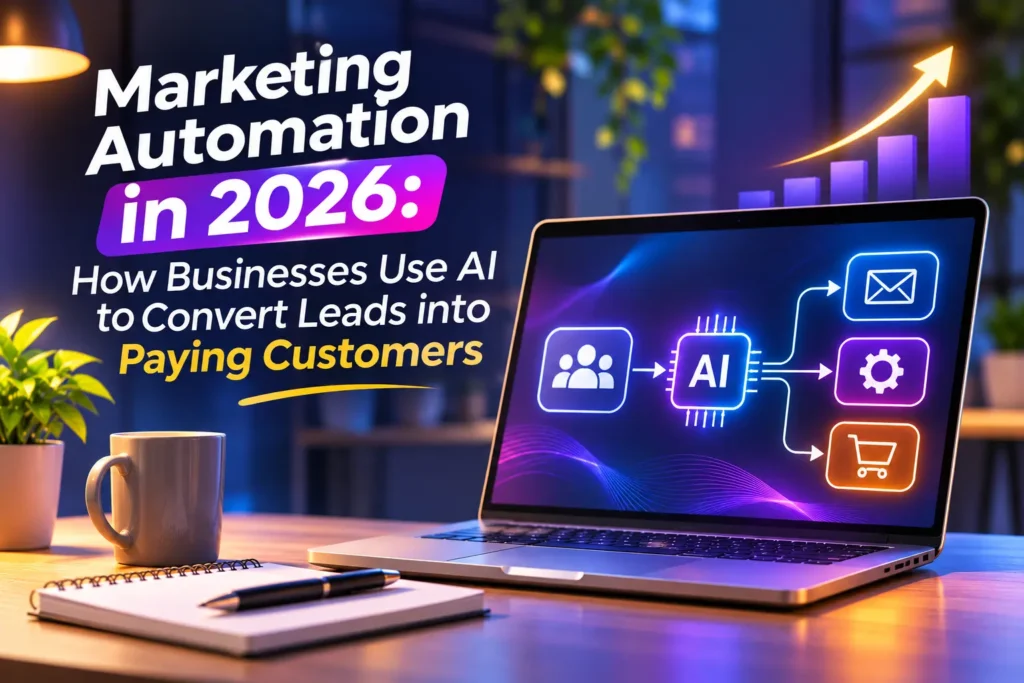
Imagine a business receiving 100 enquiries every day through its website, social media accounts, advertisements, and WhatsApp. Responding to every potential customer manually, following up with interested prospects, and tracking their buying decisions can quickly become difficult.
This is where marketing automation becomes valuable. It helps businesses manage repetitive marketing activities, communicate with potential customers, organise leads, and improve the customer journey through automated workflows.
In 2026, artificial intelligence is making these processes more intelligent. Businesses can use AI-powered tools to understand customer behaviour, personalise communication, identify promising leads, and deliver relevant messages at the right time.
For companies investing in digital marketing, understanding automation is becoming an important competitive advantage. Professionals learning through a Digital Marketing Course in Kharghar can benefit from understanding how AI, customer relationship management (CRM), email marketing, and automated lead generation work together.
But marketing automation is not simply about sending automatic emails. It is about creating a connected marketing system that moves potential customers from their first interaction to a purchase.
Marketing automation refers to using software and technology to perform repetitive marketing activities automatically. These activities include sending emails, capturing website enquiries, segmenting audiences, scheduling follow-ups, tracking customer interactions, and managing leads.
Traditional automation follows predefined rules. For example, when someone fills out a contact form, the system automatically sends a confirmation email.
AI-powered marketing automation goes further. It can analyse customer behaviour, identify patterns, recommend relevant content, and help determine which prospects are more likely to purchase.
Consider an educational institute receiving enquiries about digital marketing courses. Instead of manually contacting every person, its automated system can:
This approach reduces repetitive work and helps businesses maintain consistent communication with potential customers.
According to IBM’s 2026 explanation of AI marketing automation, combining customer data, machine learning, and predictive analytics allows businesses to make more informed marketing decisions.
IBM+1
AI is changing how businesses plan campaigns, communicate with customers, and manage sales opportunities.
Previously, marketing automation mainly depended on fixed conditions. A customer would receive the same follow-up email after completing a particular action.
Now, AI can help businesses adapt communication based on customer interests, previous interactions, engagement levels, and buying behaviour.
Some important developments include:
AI-powered customer segmentation: AI analyses customer information to identify groups with similar interests, requirements, and purchasing patterns.
Predictive lead scoring: Machine learning can help estimate which prospects are more likely to become customers based on available engagement and historical data.
Personalised communication: Businesses can create more relevant email messages, product recommendations, and promotional content.
AI chatbots and virtual assistants: Automated assistants can answer common questions, collect enquiry details, and direct conversations to the appropriate team.
AI agents: More advanced systems can perform multiple connected tasks, such as researching customer information, updating CRM records, and preparing follow-up recommendations within approved permissions.
The shift towards AI is supported by current industry research. Salesforce reported in July 2026 that 81% of marketers in India had adopted AI, while identifying fragmented customer data as an important challenge.
Salesforce+1
For businesses and professionals, the important lesson is that AI works best when connected to reliable customer information and a clearly defined marketing strategy.
Lead generation is the first important stage of the marketing automation process. A lead is someone who has shown interest in a business, product, or service by sharing contact information or interacting with a marketing channel.
Businesses generate leads through multiple sources:
Managing enquiries from different platforms manually can lead to missed opportunities. Automation helps collect and organise these enquiries in one place.
For example, a business running advertisements on Facebook and Google can connect its lead forms to a CRM platform. Whenever someone submits an enquiry, their information can automatically enter the system.
The CRM can record details such as name, email address, phone number, enquiry source, interested service, and communication history.
Businesses can then assign leads to specific sales representatives and create follow-up tasks.
A training institute targeting students interested in a Digital Marketing Course in Kharghar or a Digital Marketing Course in Panvel can use this process to organise enquiries according to course interest and preferred location.
The result is a more structured lead management process where fewer enquiries get lost between marketing and sales teams.
Not every enquiry represents the same level of purchasing interest.
Some people are simply researching their options, while others are actively comparing prices and preparing to make a purchase.
Lead scoring helps businesses prioritise prospects based on their likelihood of converting.
Traditional lead scoring uses predefined points. For example:
Customer activity | Sample points |
Visits pricing page | +10 |
Downloads course brochure | +15 |
Opens marketing email | +5 |
Requests a callback | +25 |
Attends a counselling session | +20 |
These are illustrative values, not universal industry standards.
AI-powered lead scoring can analyse more complex patterns, including previous customer behaviour, engagement frequency, enquiry history, and conversion data.
For instance, if a person visits a course page multiple times, downloads a brochure, and requests a callback, the system may identify that person as a high-priority prospect.
Sales representatives can then focus their attention on enquiries showing stronger buying signals.
However, predictive scores should not be treated as guaranteed purchase predictions. Businesses should regularly review scoring models and check whether they are producing useful results.
Email marketing remains an important channel for nurturing potential customers. However, sending identical promotional emails to every subscriber rarely provides the best experience.
Marketing automation allows businesses to create email sequences based on customer interests and actions.
For example, consider someone who downloads a brochure for a digital marketing training program.
An automated email sequence could look like this:
Timing | Automated communication |
Immediately | Send brochure and enquiry confirmation |
Day 2 | Share course curriculum and learning benefits |
Day 4 | Explain practical training and project work |
Day 6 | Answer frequently asked questions |
Day 8 | Invite the prospect to schedule counselling |
AI can help personalise email subject lines, suggest content based on customer interests, and identify suitable sending times.
Businesses can also create different email sequences for people interested in SEO, graphic design, e-commerce, or other services.
A Digital Marketing Institute in Kharghar or a Digital Marketing Institute in Panvel can use this approach to communicate course details and answer common questions without manually sending every message.
The important point is relevance. Automated emails should provide useful information instead of repeatedly pushing customers to purchase.
Explore industry-focused certification courses that combine practical training, AI-powered tools, live projects, and placement assistance to help you build a successful career in today’s digital world.
Master Digital Marketing Course in Kharghar with practical training and live projects.

Learn Amazon selling, product listing, PPC advertising, and marketplace business management professionally.

Master creative graphic designing using Photoshop, Illustrator, Canva, branding, and AI design tools.

Learn modern UI/UX design using Figma, prototyping, wireframing, and responsive design principles.
All courses are available at our Digital Marketing Institute in Kharghar, Navi Mumbai, with practical training, industry-recognized certifications, and placement assistance.
Customers increasingly expect businesses to respond quickly when they have questions about products or services.
If a visitor enquires about pricing at night or during weekends, waiting until the next working day can create unnecessary friction.
AI chatbots and messaging automation can help businesses provide initial assistance around the clock.
A chatbot can be integrated into a website or supported messaging channel to:
For example, a prospective student may ask about course duration, fees, eligibility, practical training, and available batches.
An AI-powered assistant connected to approved institute information can answer common questions and collect the student’s contact details when further assistance is required.
WhatsApp automation can also support enquiry acknowledgements, appointment reminders, and permitted follow-up communication.
However, businesses should follow applicable messaging platform policies, obtain appropriate consent, and provide a clear option for human assistance.
Automation should make communication easier, not create frustrating conversations where customers cannot reach a real person.
Content creation is one of the most time-consuming responsibilities in digital marketing. Businesses regularly need blog articles, social media posts, advertisements, email campaigns, landing pages, and promotional creatives.
AI tools can help marketing teams speed up these activities while maintaining a consistent content workflow.
Some practical applications include:
Blog and SEO content: AI can help research topics, organise article outlines, identify related questions, and prepare initial drafts.
Social media marketing: Businesses can generate content ideas, draft captions, plan posting calendars, and adapt messages for different platforms.
Advertisement creation: AI can assist with generating headline variations, promotional messages, and creative concepts for advertising campaigns.
Graphic design: AI-assisted design tools can help develop visual concepts, promotional banners, and social media creatives.
Campaign optimisation: AI can analyse available performance data and suggest improvements to targeting, messaging, and content variations.
For example, businesses exploring AI in Digital Marketing in Kharghar and AI in Digital Marketing in Panvel can use these technologies to understand how marketing teams create and manage campaigns more efficiently.
Professionals can also develop complementary creative skills through a Graphic Design Course in Kharghar and Panvel.
However, AI-generated content still requires human review. Marketers must check factual accuracy, originality, brand consistency, readability, and relevance before publishing.
The objective is to use AI as a productivity tool while maintaining human creativity and strategic judgement.
Understanding customer behaviour helps businesses make better marketing decisions.
Traditional marketing analysis often involves manually reviewing website visits, advertisement performance, customer enquiries, and purchase records.
AI can help process large amounts of information and identify patterns that may not be immediately visible.
For example, an online shopping business might discover that customers who visit a particular product category, read customer reviews, and return to the website within three days are more likely to purchase.
AI-powered systems can use historical information to identify similar behavioural patterns and suggest appropriate marketing actions.
Predictive marketing can support:
Businesses should remember that predictive analytics depends on data quality. Incomplete, outdated, or inaccurate information can lead to misleading recommendations.
A good marketing automation strategy therefore starts with organised customer data, clear objectives, and regular performance reviews.
Online retailers receive visitors who browse products, compare prices, add items to their shopping carts, and sometimes leave without completing their purchases.
Marketing automation helps businesses reconnect with these visitors through relevant communication.
Consider an online store selling electronic accessories. A visitor adds a product to their cart but leaves the website before completing the payment.
The business can trigger an automated abandoned-cart reminder, subject to customer consent and applicable platform requirements.
Other useful e-commerce automation activities include:
AI can further support product recommendations and customer segmentation by analysing purchasing patterns and product interests.
For aspiring professionals, learning e-commerce marketing can provide another career opportunity. An Amazon E-commerce Course in Kharghar and Panvel can help learners understand product listings, Amazon SEO, marketplace advertising, and online selling fundamentals.
These skills complement marketing automation because successful e-commerce campaigns require coordination between product visibility, customer communication, advertising, and sales.
Businesses do not need to build their own automation systems from scratch. Several platforms offer tools for managing customer relationships, campaigns, and automated workflows.
Here are some platforms worth exploring:
Tool | Primary purpose |
HubSpot | CRM, email marketing, lead management and automation |
Salesforce | Customer relationship management and AI-supported sales workflows |
Mailchimp | Email campaigns and marketing automation |
Zoho CRM | Lead management, sales tracking and workflow automation |
ActiveCampaign | Email marketing and customer journey automation |
Zapier | Connecting different applications and automating workflows |
Make | Building visual, multi-step automation workflows |
Manychat | Automating supported messaging and social interactions |
The right platform depends on business size, budget, existing software, marketing objectives, and technical requirements.
A small business may begin with a basic CRM and email automation system, while a larger organisation may require advanced integrations across marketing, sales, and customer support.
Before selecting a tool, check its pricing, available integrations, data protection features, automation limits, and scalability.
Implementing automation is not enough. Businesses must measure whether it is generating better marketing and sales outcomes.
The following metrics can help evaluate performance:
Metric | What it measures |
Lead Generation | Number of enquiries generated |
Lead Conversion Rate | Percentage of leads becoming customers |
Email Open Rate | Percentage of delivered emails opened |
Click-Through Rate | Percentage of recipients clicking links |
Cost Per Lead | Marketing expenditure per generated lead |
Customer Acquisition Cost | Average cost of acquiring a customer |
Return on Investment | Financial return relative to investment |
Sales Cycle Length | Time taken to convert a lead into a customer |
For example, a company may generate 200 enquiries through digital advertising but convert only 10 into paying customers.
Instead of increasing the advertising budget immediately, the marketing team should investigate the complete customer journey.
Are leads receiving timely responses? Is the sales team following up? Are customers receiving relevant information? Is the pricing clear? Are there unnecessary steps in the buying process?
Marketing automation can help identify and address these gaps, but improving conversion rates requires coordination between marketing, sales, and customer service.
For professionals learning digital marketing, understanding analytics and reporting is just as important as learning how to operate automation tools.
Although automation provides several advantages, implementing it without a clear strategy can create problems.
Poor-quality customer data: Incorrect contact details, duplicate records, and incomplete information can affect segmentation and communication.
Over-automation: Sending too many messages can frustrate customers and reduce engagement.
Lack of personalisation: Automated communication that feels generic may fail to build customer relationships.
Integration difficulties: Different software platforms may not share information correctly, creating disconnected workflows.
Privacy and consent: Businesses must handle customer information responsibly and follow applicable data protection and communication requirements.
Dependence on AI: AI-generated recommendations can be inaccurate. Important customer-facing decisions and sensitive communications need appropriate human oversight.
Businesses should begin with simple workflows, test them carefully, monitor performance, and expand automation only when the process delivers measurable value.
According to Salesforce’s 2026 India marketing findings, disconnected customer data remains a significant obstacle to effective AI-powered customer engagement.
Salesforce+1
Marketing automation is becoming an important skill for professionals who want to work in SEO, performance marketing, social media, email marketing, lead generation, and e-commerce.
Employers increasingly value people who can combine marketing knowledge with technology and analytical thinking.
Before entering this field, learners should understand:
A structured Digital Marketing Course in Kharghar or Digital Marketing Course in Panvel can provide a foundation for understanding these areas, especially when practical assignments are included.
Learners can also explore AI in Digital Marketing in Kharghar and AI in Digital Marketing in Panvel to understand how artificial intelligence is influencing modern marketing responsibilities.
The goal should be to develop practical knowledge rather than simply collect certificates. Build sample workflows, practise using CRM platforms, and understand how automated campaigns support business objectives.
For additional professional development, complementary learning options such as the MS Office Course in Kharghar can also strengthen everyday workplace productivity.
If you are new to digital marketing, you do not need to learn every automation platform at once. Start with the fundamentals and gradually develop practical experience.
Here is a simple learning roadmap:
Stage | What to learn | Practical activity |
1 | Digital marketing fundamentals | Create a basic marketing strategy |
2 | Lead generation | Build a sample enquiry form |
3 | CRM management | Organise and categorise leads |
4 | Email automation | Create a five-email follow-up sequence |
5 | AI marketing tools | Develop personalised campaign content |
6 | Chatbot automation | Create a sample enquiry chatbot |
7 | Analytics | Prepare a campaign performance report |
You can practise these activities using sample business scenarios before working with actual clients.
Students looking for a Digital Marketing Course in Kharghar should check whether the curriculum covers AI tools, CRM fundamentals, and practical marketing projects.
Similarly, anyone comparing a Digital Marketing Course in Panvel should evaluate the institute’s practical training approach and opportunities to work with industry-relevant tools.
A good Digital Marketing Institute in Kharghar should help learners understand how different marketing channels work together.
When evaluating a Digital Marketing Institute in Panvel, also consider mentor guidance, project work, and career preparation.
Learners interested in AI in Digital Marketing in Kharghar should practise using AI for customer research, content planning, and campaign analysis.
Likewise, AI in Digital Marketing in Panvel can be explored through practical assignments involving lead qualification and personalised marketing workflows.
Creative learners can consider a Graphic Design Course in Kharghar and Panvel, while those interested in online retail can explore an Amazon E-commerce Course in Kharghar and Panvel.

360 Digital Marketing Institute is a leading Digital Marketing Institute in Kharghar, offering practical training in SEO, Google Ads, Social Media Marketing, AI Marketing, WordPress, Graphic Design, UI/UX Design, and Amazon eCommerce. Learn through live projects, industry certifications, and placement assistance.
© 2026 | 360 Digital Marketing Institute. | All Rights Reserved
Serving students from Kharghar, Panvel, Kamothe, Kalamboli, Belapur, Nerul, Vashi, Thane, Dombivli, Kalyan, Mulund, Ghatkopar, Kurla, Dadar, and nearby locations across Mumbai and Navi Mumbai.