Top SEO Mistakes Small Businesses Make When Trying to Rank on Google
Top 5 SEO Mistakes Small Businesses Make When Trying to Rank on Google For small businesses, appearing on the first...
Read More →
Search is changing.
For years, digital marketers focused primarily on SEO (Search Engine Optimization) to help websites appear on Google and other traditional search engines. But the growth of AI-powered search and conversational platforms is creating a new way for people to discover information.
Instead of searching for ten blue links, users can now ask AI systems complete questions and receive summarized answers, recommendations, comparisons, and sources.
This shift has introduced a growing marketing discipline known as Generative Engine Optimization (GEO).
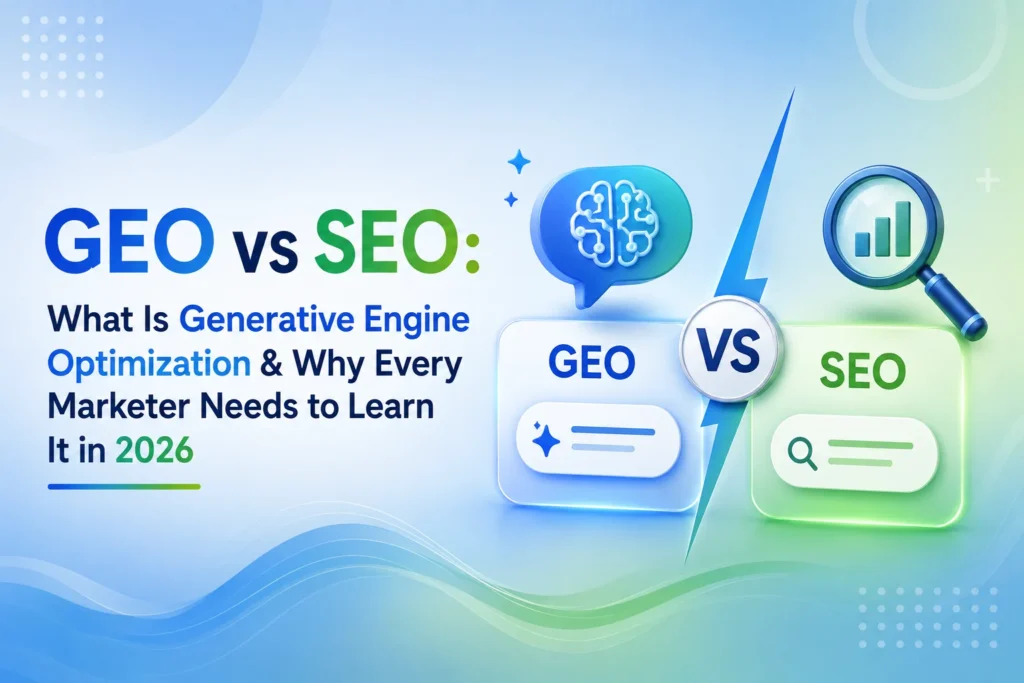
So, what is the difference between GEO vs SEO? Is GEO replacing traditional SEO? And why should digital marketers learn AI search optimization in 2026?
The answer is important for anyone building a career in modern digital marketing.
Generative Engine Optimization, commonly called GEO, is the process of improving a brand’s online presence and content so it has a better chance of being understood, referenced, or represented in responses generated by AI-powered search and answer systems.
Traditional SEO primarily aims to improve a website’s visibility in search engine results pages.
GEO focuses on visibility within AI-generated answers and conversational search experiences.
For example, a user might ask an AI search system:
“What are the best digital marketing institutes for practical training?”
Instead of receiving only a list of webpages, the user may receive a synthesized answer mentioning several organizations.
The goal of GEO is to increase the likelihood that your business, website, expertise, or content becomes part of that discovery journey.
SEO and GEO are closely related, but they focus on different search experiences.
| SEO | GEO |
|---|---|
| Optimizes for traditional search engines | Optimizes for generative AI search experiences |
| Focuses heavily on search rankings | Focuses on being represented in AI-generated answers |
| Targets keywords and search queries | Targets questions, entities, topics, and context |
| Click-through traffic is a major objective | Visibility, mentions, citations, and qualified discovery can be important |
| Relies on technical SEO, content, links, and authority | Builds on content quality, authority, clarity, structured information, and broader online signals |
| Primarily produces search-result visibility | Can influence conversational discovery |
However, this does not mean SEO and GEO are competing strategies.
In many cases, strong SEO fundamentals can support GEO efforts.
A technically sound website with useful content, clear information, strong topical authority, and credible references provides a much stronger foundation for AI search visibility.
No.
One of the biggest misconceptions about GEO is that marketers should abandon SEO.
SEO remains important because traditional search engines continue to drive substantial discovery and website traffic.
Instead, digital marketers should think about the evolution like this:
SEO → Search visibility
GEO → AI-generated answer visibility
Modern search strategy → SEO + GEO
The search ecosystem is becoming more diverse. Users may discover a business through Google, an AI chatbot, YouTube, social media, maps, review platforms, or other digital channels.
A modern marketer therefore needs to understand how content is discovered across multiple search environments.
AI-powered search is changing user behavior.
Instead of searching for a short keyword such as:
“digital marketing course”
a user may ask a much more detailed question:
“Which digital marketing course is suitable for a beginner who wants practical SEO and Google Ads experience?”
This creates an opportunity for businesses that publish genuinely useful, detailed, and trustworthy information.
The content that performs well in this environment needs to do more than repeat keywords.
It needs to demonstrate:
This is why AI search optimization is becoming an increasingly relevant skill for digital marketers.
There is no single optimization technique that guarantees an AI system will mention a particular business or website.
Instead, GEO is better understood as a broader approach to building machine-readable, trustworthy, context-rich online visibility.
1. Create Clear, Useful Content
AI systems need to understand what your content is about.
Content should answer real questions clearly rather than being created solely around keyword density.
For example, instead of creating a short page repeatedly mentioning “digital marketing course,” create a comprehensive resource explaining:
This gives search systems more useful context.
2. Build Topical Authority
One article rarely establishes expertise around an entire subject.
A stronger approach is to create interconnected content around related topics.
For a digital marketing education website, this could include:
Digital Marketing
→ SEO
→ Local SEO
→ Google Ads
→ Social Media Marketing
→ Content Marketing
→ AI Marketing
→ Digital Marketing Careers
→ Digital Marketing Courses
This creates a broader topical ecosystem that can help search systems understand the site’s expertise.
3. Answer Specific Questions
Generative search is highly conversational.
People ask questions such as:
Creating content that directly answers these questions can make your website more useful for conversational search.
4. Strengthen Brand and Entity Signals
GEO is not only about individual webpages.
AI systems can use information from multiple sources when developing an understanding of an organization, person, product, or business.
Consistent information across your website and legitimate external platforms can help establish clearer entity signals.
For businesses, this can include accurate:
Consistency matters because contradictory information can create ambiguity.
5. Demonstrate First-Hand Expertise
AI-generated content is abundant.
Simply publishing large quantities of generic AI-written articles is therefore unlikely to be a sustainable competitive advantage.
Content should provide something useful that generic content cannot easily replicate.
For example:
This can make content more distinctive and valuable. SEO?
You may also come across the term GEO SEO.
GEO SEO is generally used to describe the intersection between traditional search optimization and generative engine optimization.
Rather than treating GEO and SEO as completely separate disciplines, marketers can combine their principles.
A modern content strategy might therefore look like:
Keyword research + search intent + high-quality content + topical authority + structured information + brand authority + AI search optimization
This approach helps businesses prepare for multiple forms of search discovery.
The role of a digital marketer is expanding.
A few years ago, marketers primarily needed to understand search engines, social media platforms, advertising systems, websites, and analytics.
Today, they also need to understand how AI is changing discovery.
A marketer who understands both SEO and GEO can think beyond traditional rankings and consider the entire search ecosystem.
This can be particularly valuable for:
Understanding GEO does not mean becoming an AI engineer.
It means understanding how AI-powered discovery is changing digital marketing and adapting your strategy accordingly.
If you’re considering a digital marketing course in Panvel, look for training that goes beyond traditional modules and introduces emerging areas such as AI-assisted marketing, AI search optimization, content strategy, and Generative Engine Optimization.
A modern digital marketing curriculum should ideally connect GEO with existing skills such as:
Practical projects are particularly useful because GEO is easier to understand when you actually analyze search queries, create structured content, strengthen topical authority, and evaluate how businesses are represented across different search environments.
The debate around GEO vs SEO should not be viewed as a choice between two competing strategies.
SEO helps businesses build visibility in traditional search. Generative Engine Optimization focuses on improving how businesses and their content can be understood and represented in AI-powered search experiences.
In 2026, marketers should learn both.
The fundamentals remain important: useful content, strong technical foundations, search intent, topical authority, credibility, and a good user experience.
But the search landscape is expanding beyond traditional results pages.
By developing skills in GEO SEO, AI search optimization, content strategy, SEO, analytics, and AI tools, digital marketers can prepare themselves for the next stage of online discovery.
If you’re planning to build a career in digital marketing, learning how search is evolving today can give you an advantage tomorrow.

360 Digital Marketing Institute is a leading Digital Marketing Institute in Kharghar, offering practical training in SEO, Google Ads, Social Media Marketing, AI Marketing, WordPress, Graphic Design, UI/UX Design, and Amazon eCommerce. Learn through live projects, industry certifications, and placement assistance.
© 2026 | 360 Digital Marketing Institute. | All Rights Reserved
Serving students from Kharghar, Panvel, Kamothe, Kalamboli, Belapur, Nerul, Vashi, Thane, Dombivli, Kalyan, Mulund, Ghatkopar, Kurla, Dadar, and nearby locations across Mumbai and Navi Mumbai.