How to Build Subscriber Lists, Improve Open Rates and Generate Sales
How to Build Subscriber Lists, Improve Open Rates and Generate Sales Email marketing remains an important part of digital marketing...
Read More →
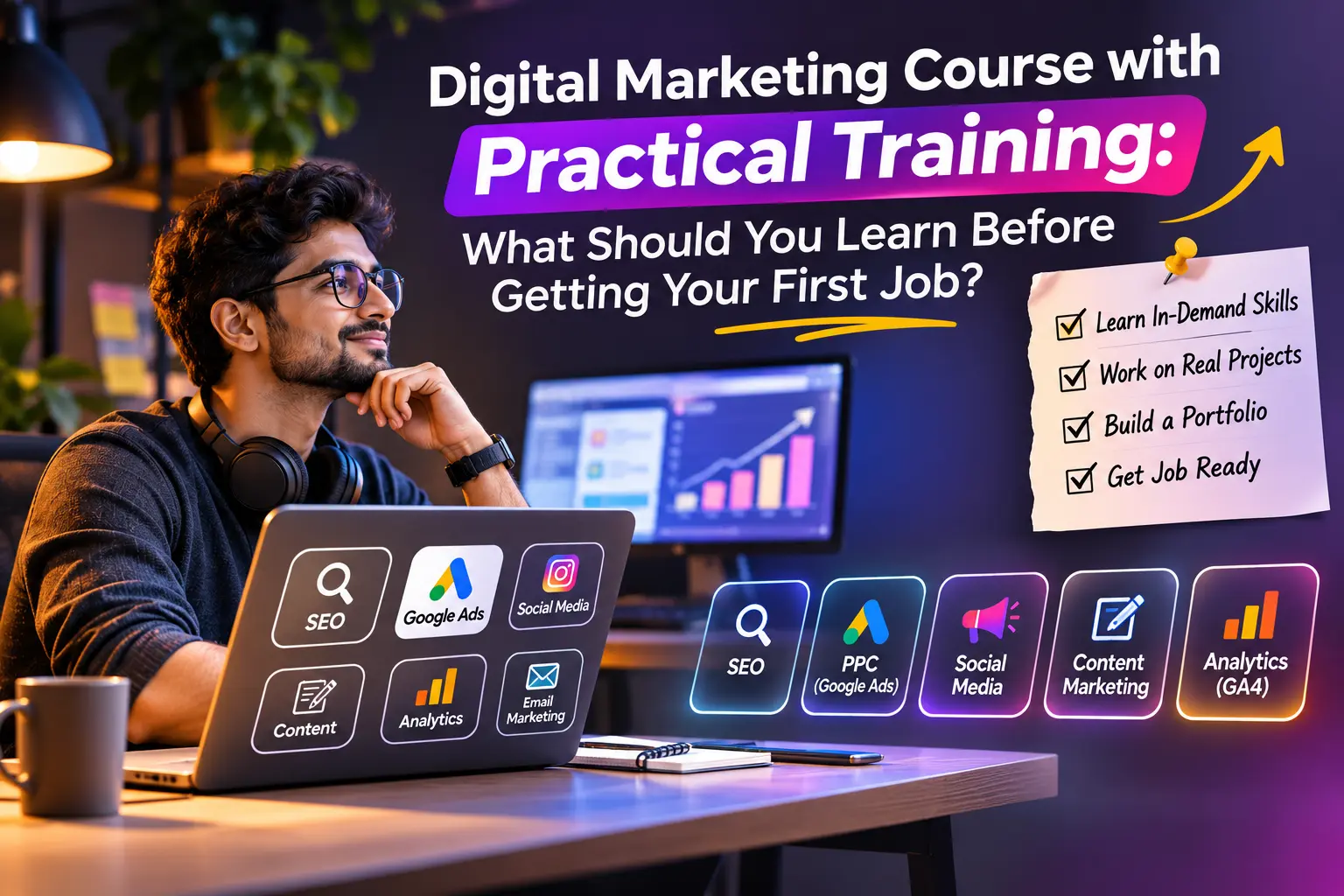
Starting your career in digital marketing can open doors to exciting opportunities in SEO, social media marketing, paid advertising, content creation, e-commerce, and analytics. However, understanding marketing concepts alone is not enough to succeed in your first job. Employers want candidates who can apply their knowledge to real business challenges, work with digital tools, and measure campaign performance.
Enrolling in a Digital Marketing Course in Kharghar can help beginners understand these essential skills through structured learning and practical assignments. Whether you are a student, recent graduate, job seeker, or working professional planning a career change, the right training can help you develop confidence and prepare for entry-level roles.
The key is to choose a program that combines theoretical knowledge, hands-on practice, industry-relevant tools, and portfolio development. Before applying for your first digital marketing job, here is what you should learn and how you can prepare for the workplace.
Before learning advanced strategies, understand how digital marketing helps businesses attract customers, generate leads, increase sales, and build brand awareness.
Digital marketing includes several channels, such as search engines, social media platforms, email, websites, online advertising, and e-commerce marketplaces. Each channel serves a different purpose, but successful campaigns connect them to achieve measurable business goals.
Start by learning the difference between traditional and digital marketing, understanding target audiences, identifying customer needs, and exploring the customer journey from awareness to purchase.
You should also learn how businesses define their target markets, create marketing objectives, research competitors, and select suitable promotional channels.
A practical Digital Marketing Course in Panvel can introduce these concepts through business examples and assignments. For instance, you might develop a simple marketing strategy for a local restaurant, educational institute, or online clothing store.
By completing such exercises, you learn how marketing decisions relate to actual business objectives rather than simply memorising definitions.
Search engine optimization is one of the most valuable skills for aspiring digital marketers. SEO helps websites improve their visibility in organic search results and attract people who are actively looking for relevant information, products, or services.
Before your first job, understand the three main areas of SEO.
On-page SEO: Learn keyword research, title tags, meta descriptions, heading structure, internal linking, URL optimisation, image alt text, and content optimisation.
Off-page SEO: Understand backlinks, link quality, digital PR, brand mentions, and ethical link-building practices.
Technical SEO: Learn website indexing, crawlability, XML sitemaps, robots.txt, canonical tags, mobile usability, page speed, and structured data basics.
Practical training should include keyword research for a real website, identifying content gaps, optimising a sample webpage, and preparing an SEO audit report.
You should also become familiar with Google Search Console and Google Analytics 4. These tools help you evaluate search visibility, traffic, and website performance.
Students considering a Digital Marketing Institute in Kharghar should look for training that includes live projects, keyword mapping, SEO reporting, and content optimisation rather than theory alone.
Remember that SEO takes time. Your goal as a beginner is to understand how to identify opportunities, implement improvements, and monitor results consistently.
Social media marketing helps businesses connect with audiences, promote products, build communities, and generate leads through platforms such as Instagram, Facebook, LinkedIn, and YouTube.
To prepare for a digital marketing role, learn how to choose the right platform for a business, understand audience behaviour, plan content, and maintain a consistent brand identity.
You should know how to create a content calendar, write engaging captions, develop calls to action, research relevant hashtags where appropriate, and select suitable formats for different platforms.
For example, an educational institute may publish student success stories, course explainers, informative reels, and career tips. A B2B company might focus on industry insights, case studies, LinkedIn posts, and lead-generation campaigns.
Practical assignments should involve planning at least one week of social media content, creating sample posts, writing captions, and defining the objective of each post.
You should also learn the basics of Meta Business Suite, scheduling content, responding professionally to comments, and understanding engagement metrics.
A Digital Marketing Institute in Panvel that provides practical social media assignments can help you build a portfolio that demonstrates your ability to plan and execute campaigns.
Your first job may involve several responsibilities at once, so practise managing content deadlines, maintaining brand consistency, and communicating clearly with clients or team members.
Paid advertising allows businesses to reach potential customers through targeted campaigns. Unlike organic marketing, paid campaigns can generate visibility quickly, although results depend on targeting, budget, creative quality, and campaign optimisation.
Before applying for your first job, learn the fundamentals of Google Ads, including search campaigns, keyword match types, negative keywords, bidding strategies, ad copy, conversion tracking, and landing page relevance.
You should understand how advertising budgets work and how to calculate basic performance metrics.
For practical learning, create a sample campaign structure for a local business. Research relevant keywords, write ad headlines, identify negative keywords, and design a suitable landing page plan.
You can also explore official Google Ads learning resources and practise with campaign simulations or supervised campaigns. Never assume that a sample campaign automatically produces real advertising results.
A strong beginner should be able to explain why an ad campaign needs a clear objective, a defined audience, relevant messaging, and measurable conversions.
Artificial intelligence is becoming an important part of modern marketing workflows. AI tools can support research, content ideation, audience analysis, campaign planning, reporting, and creative development.
However, using AI effectively requires more than generating text. You need to understand how to give clear instructions, evaluate outputs, fact-check information, and improve the results using your marketing knowledge.
When exploring AI in Digital Marketing in Kharghar, focus on practical applications such as generating blog outlines, developing social media content ideas, analysing customer feedback, preparing campaign variations, and organising keyword research.
You should also learn the limitations of AI-generated content. Outputs may contain factual errors, repetitive language, outdated information, or unsupported claims. Human review remains essential.
For example, you could use an AI assistant to draft five ad headline variations, then evaluate which messages best match a specific audience and campaign objective.
Similarly, AI in Digital Marketing in Panvel can be explored through assignments involving content workflows, marketing research, creative brainstorming, and report summaries.
Learn to protect confidential business information, avoid uploading sensitive customer data to unauthorised tools, and respect copyright and platform policies.
The most valuable skill is knowing when AI can improve efficiency and when human judgement, original thinking, or additional research is necessary.
Content plays a central role in digital marketing. Websites need informative pages, blogs attract organic traffic, social media requires engaging captions, and advertisements need persuasive messaging.
Before your first job, learn to write clear, useful, audience-focused content.
Start with basic grammar, sentence structure, readability, headline writing, calls to action, and brand tone. Practise writing content for different audiences rather than using the same style for every business.
For SEO content, learn search intent. A person searching for a beginner’s guide needs a different answer from someone comparing service providers or looking to make an immediate purchase.
You should be able to write:
Practical training should include editing existing content, checking factual accuracy, improving readability, and incorporating keywords naturally.
Avoid keyword stuffing or publishing generic AI-generated articles without review. Content should answer the reader’s question and provide genuine value.
Build a small writing portfolio with different content formats. This helps recruiters understand your communication skills even if you do not have previous professional experience.
Explore industry-focused certification courses that combine practical training, AI-powered tools, live projects, and placement assistance to help you build a successful career in today’s digital world.
Master Digital Marketing Course in Kharghar with practical training and live projects.

Learn Amazon selling, product listing, PPC advertising, and marketplace business management professionally.

Master creative graphic designing using Photoshop, Illustrator, Canva, branding, and AI design tools.

Learn modern UI/UX design using Figma, prototyping, wireframing, and responsive design principles.
All courses are available at our Digital Marketing Institute in Kharghar, Navi Mumbai, with practical training, industry-recognized certifications, and placement assistance.
Digital marketers often collaborate with designers, but basic design knowledge can make you more effective. Understanding visual communication helps you create better social media creatives, advertisements, presentations, and campaign assets.
A Graphic Design Course in Kharghar and Panvel can be relevant for learners who want to develop complementary creative skills alongside digital marketing.
Start with design fundamentals such as colour theory, typography, spacing, visual hierarchy, image selection, alignment, and brand consistency.
Practise creating social media posts, banners, promotional graphics, and simple presentation layouts using accessible design tools such as Canva. You can explore professional software such as Adobe Photoshop and Illustrator as your skills develop.
Learn how to choose the correct dimensions for different platforms, export suitable file formats, optimise images for web use, and maintain readable text on mobile screens.
A useful assignment is to design a small campaign for a fictional business, including three social media creatives, a promotional banner, and a consistent visual theme.
You do not need to become an expert graphic designer to start a digital marketing career. However, understanding design principles can improve collaboration, reduce communication gaps, and help you evaluate creative performance more effectively.
A website is often the destination for digital marketing campaigns. Even if you are not applying for a web developer position, basic website knowledge can help you work more effectively.
Learn how websites are structured, how navigation affects user experience, and why mobile responsiveness, loading speed, clear calls to action, and accessible content matter.
Explore WordPress basics, including pages, posts, menus, media uploads, and simple content updates. You should also understand the purpose of landing pages and how their design influences lead generation.
For example, a campaign promoting a training program should direct visitors to a relevant page that explains the course, benefits, eligibility, and next steps.
Practise reviewing a sample website and identifying issues such as confusing navigation, missing contact details, weak headlines, or poorly placed enquiry forms.
Basic website skills can be useful in SEO, content marketing, lead generation, and e-commerce roles. They also help you communicate more clearly with developers when technical changes are required.
Digital marketing professionals must understand whether their campaigns are achieving their objectives. Analytics helps you identify what is working, what needs improvement, and where marketing resources should be allocated.
Start with Google Analytics 4, Google Search Console, and the reporting dashboards available on social media and advertising platforms.
Learn to interpret sessions, users, traffic sources, engagement, conversions, impressions, clicks, and other metrics relevant to a campaign.
Do not focus on numbers without understanding their meaning. An increase in website traffic may appear positive, but the campaign may still underperform if visitors do not take the desired action.
Practise preparing a simple monthly report with campaign objectives, key metrics, major observations, and recommended next steps.
For example, if a landing page receives many visits but few enquiries, investigate the relevance of the traffic, page messaging, user experience, and enquiry form before recommending changes.
Employers value candidates who can explain data clearly and connect it to business goals. Reporting should not merely list numbers; it should explain what the numbers suggest and what the team should test next.
E-commerce marketing is another useful career direction for beginners interested in online retail and marketplace management.
An Amazon E-commerce Course in Kharghar and Panvel can help learners explore product listings, marketplace optimisation, product research, and advertising fundamentals.
Start by understanding how online marketplaces operate and how product titles, images, bullet points, descriptions, pricing, availability, and customer reviews influence purchasing decisions.
Learn the basics of Amazon SEO, including relevant keyword research and listing optimisation. You should also understand the purpose of Amazon Sponsored Products advertising and how sellers evaluate clicks, conversions, advertising costs, and sales performance.
Practical assignments may include preparing a sample product listing, researching competitor listings, writing product descriptions, and creating an advertising plan for a hypothetical product.
You should also become familiar with inventory considerations, order fulfilment concepts, customer service, and marketplace policies.
A digital marketing professional who understands e-commerce can support online retailers with product visibility, advertising, conversion optimisation, and performance reporting.
The objective is not simply to upload products but to understand how product information, customer expectations, advertising, and marketplace requirements work together.
One of the biggest challenges for freshers is demonstrating practical ability without previous employment experience. A portfolio helps bridge this gap.
You do not need to wait for a company to hire you before creating examples of your work. You can develop practice projects using fictional businesses, publicly available information, or supervised assignments.
Your portfolio can include:
For every project, explain the objective, your approach, tools used, and expected outcome. Clearly label hypothetical results as sample or simulated data.
If you work on a real client project, obtain permission before sharing confidential information or unpublished campaign details.
You can organise your work in a simple portfolio document, presentation, or online page. A well-structured portfolio allows recruiters to assess your thinking, creativity, attention to detail, and practical knowledge.
Technical skills are essential, but workplace success also depends on communication and professionalism.
Digital marketers often coordinate with clients, designers, developers, content writers, sales teams, and managers. You must be able to explain your work, ask relevant questions, manage deadlines, and accept feedback.
Practise writing professional emails, preparing concise reports, presenting campaign ideas, and discussing performance metrics in simple language.
During interviews, employers may ask how you would improve a website’s search visibility, plan social media content, measure an advertising campaign, or investigate declining traffic.
Prepare by explaining your thought process instead of memorising answers. If you do not know something, demonstrate how you would research the problem and identify a solution.
You should also understand the job description before applying. An SEO executive, social media executive, performance marketing trainee, and e-commerce executive may require different skill combinations.
Review the tools and responsibilities mentioned in each job posting, then align your learning and portfolio with the role you want.
The quality of your training can influence how confidently you enter the job market. Compare institutes based on practical learning, curriculum, mentor support, project opportunities, and career guidance rather than selecting a course only because of its duration or advertised certificate.
Before enrolling, ask these questions:
Learners comparing a Digital Marketing Course in Kharghar with other local training options should review the actual syllabus and practical components before making a decision.
You can explore the 360 Digital Marketing Institute website to learn more about its training offerings. Visit the courses page to compare available learning options.
For additional details, review the digital marketing course page, read the institute’s background, and download the course brochure.
You can also explore the Graphic Design course, the Amazon E-commerce course, and the MS Office course if you want to strengthen complementary skills.
For further learning, visit the institute’s blog section or use the contact page to ask about course details, training methods, and available support.
If you are planning to enter digital marketing, a structured preparation plan can help you organise your learning.
Week | Learning focus | Practical task |
Week 1 | Digital marketing fundamentals and SEO | Research keywords and optimise a sample webpage |
Week 2 | Social media and content writing | Create a seven-day content calendar and sample blog |
Week 3 | Google Ads, AI tools, and analytics | Prepare a sample campaign plan and performance report |
Week 4 | Website basics and career preparation | Complete a portfolio and practise interview questions |
This is a foundation-building plan, not a guarantee of job readiness in 30 days. Your progress will depend on your starting knowledge, time commitment, practice quality, and the complexity of the skills you want to develop.
Continue practising after the first month. Review your work, seek feedback, explore official tool documentation, and improve projects based on what you learn.
Getting your first digital marketing job becomes easier when you can demonstrate more than theoretical knowledge. Learn SEO, social media marketing, Google Ads, content writing, analytics, AI tools, and basic website management. Develop complementary skills in graphic design or e-commerce if they match your career interests.
A structured Digital Marketing Course in Panvel or another suitable local training program can help you organise your learning, practise industry-relevant tasks, and develop a portfolio.
Remember that certificates can support your profile, but your ability to solve problems, interpret data, communicate clearly, and complete practical assignments is equally important.
Start with the fundamentals, practise consistently, and focus on building projects that demonstrate your abilities. With a clear learning plan and realistic expectations, you can prepare for entry-level opportunities and continue growing as the digital marketing industry evolves.
Ready to explore your learning options? Visit 360 Digital Marketing Institute to review the available courses and contact the team for further information.

360 Digital Marketing Institute is a leading Digital Marketing Institute in Kharghar, offering practical training in SEO, Google Ads, Social Media Marketing, AI Marketing, WordPress, Graphic Design, UI/UX Design, and Amazon eCommerce. Learn through live projects, industry certifications, and placement assistance.
© 2026 | 360 Digital Marketing Institute. | All Rights Reserved
Serving students from Kharghar, Panvel, Kamothe, Kalamboli, Belapur, Nerul, Vashi, Thane, Dombivli, Kalyan, Mulund, Ghatkopar, Kurla, Dadar, and nearby locations across Mumbai and Navi Mumbai.