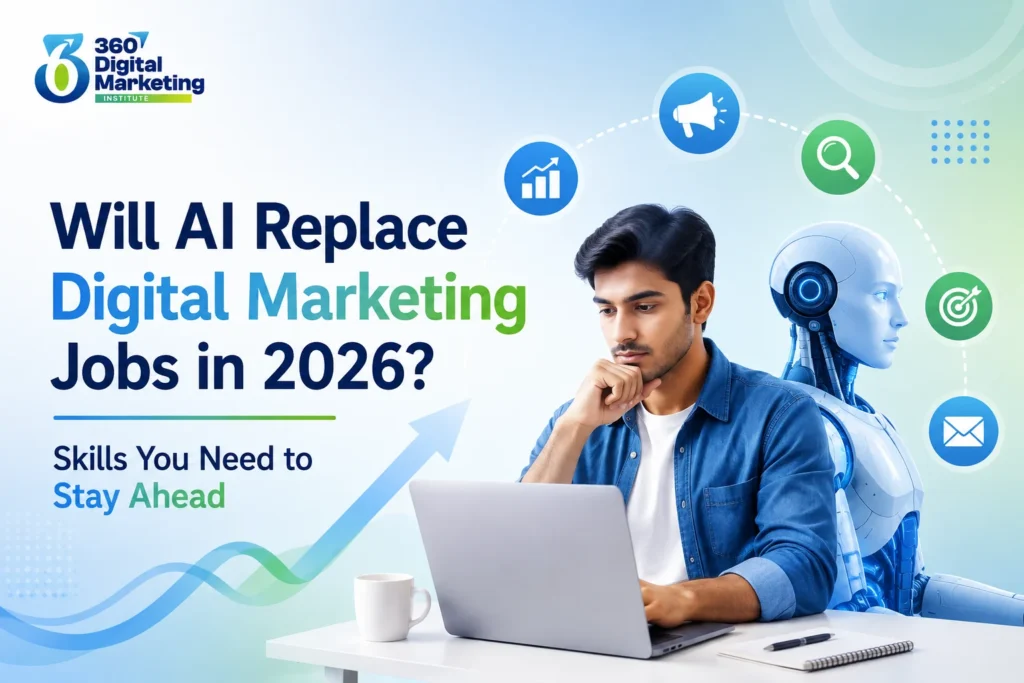
Will AI Replace Digital Marketing Jobs in 2026? Skills You Need to Stay Ahead
Artificial intelligence has changed the way businesses approach digital marketing. From generating content and analyzing data to automating advertising campaigns and assisting with SEO research, AI tools are becoming part of everyday marketing workflows.
This has also created an important question for students and professionals: Will AI replace digital marketing jobs in 2026?
The short answer is that AI is more likely to change digital marketing jobs than completely replace them. Certain repetitive tasks can already be automated, but businesses still need marketers who can understand customers, develop strategies, make decisions, manage campaigns, and turn data into meaningful business outcomes.
For anyone planning a career in digital marketing, the key is not to compete against AI but to learn how to work effectively with it.
Related Blogs
GEO vs SEO: What Is Generative Engine Optimization & Why Every Marketer Needs to Learn It in 2026
Social Media SEO in 2026: How to Get Found on Instagram, YouTube & LinkedIn Without Going Viral
How Is AI Changing Digital Marketing?
AI is being used across almost every major area of digital marketing.
Marketers can use AI tools to assist with:
- Keyword and topic research
- Content ideation
- Content creation and editing
- SEO analysis
- Competitor research
- Social media content planning
- Ad copy variations
- Audience analysis
- Marketing analytics
- Customer segmentation
- Campaign optimization
- Reporting and data analysis
These capabilities can significantly reduce the time required for repetitive tasks.
For example, a marketer may use AI to generate initial content ideas or analyze large amounts of campaign data. However, the marketer still needs to determine whether the information is accurate, relevant, useful, and aligned with the business objective.
This is where human expertise remains important.
Will AI Replace Digital Marketing Jobs?
AI may automate tasks, but that does not necessarily mean it will eliminate entire digital marketing careers.
Consider SEO as an example. AI can help with keyword research, content ideas, competitor analysis, and data interpretation. But an SEO professional still needs to understand search intent, website architecture, technical SEO, content quality, internal linking, user experience, and the overall business strategy.
Similarly, AI can help create advertising copy, but performance marketers still need to decide:
- Who should be targeted?
- What campaign objective should be used?
- How should the budget be allocated?
- Which landing page should users reach?
- Why is one campaign outperforming another?
- What should be changed based on performance data?
These decisions require marketing knowledge and business judgment.
The professionals most at risk are likely to be those who perform only repetitive, easily automated tasks without developing deeper strategic or technical skills.
Which Digital Marketing Tasks Can AI Automate?
Understanding what AI can and cannot do is important for anyone entering the industry.
Content Creation
AI can quickly generate drafts, headlines, ideas, outlines, social media captions, and other forms of content.
However, marketers still need to provide strategy, fact-check information, add expertise, understand the target audience, and ensure that content actually serves a purpose.
Data Analysis
AI can process large amounts of marketing data much faster than a human.
It can help identify patterns, summarize reports, and highlight unusual changes in performance.
The marketer’s role is to interpret those insights and determine what action the business should take.
Advertising
AI-powered advertising platforms can automate parts of bidding, targeting, creative testing, and campaign optimization.
However, businesses still require professionals who understand campaign objectives, customer journeys, budgets, creative strategy, conversion tracking, and profitability.
SEO Research
AI can assist with keyword research, competitor analysis, content gaps, and topic discovery.
But SEO professionals still need to understand search intent, technical optimization, website structure, content quality, and how different SEO activities contribute to business growth.
Skills Digital Marketers Need in 2026
As AI becomes more common, the skills required from digital marketers are changing.
1. SEO Skills
SEO remains an important digital marketing skill. Professionals should understand keyword research, on-page SEO, technical SEO, local SEO, content optimization, internal linking, and performance analysis.
AI can assist with research, but marketers need to know why an optimization should be made and how it supports search visibility and business goals.
2. Data and Analytics
Being able to read and interpret data is becoming increasingly valuable.
Digital marketers should understand metrics such as:
- Traffic
- Engagement
- Leads
- Conversions
- Conversion rate
- Cost per lead
- Return on ad spend
- Customer acquisition cost
The goal isn’t simply to collect numbers. It is to understand what those numbers mean and what action should follow.
3. Strategic Thinking
Strategy is one of the areas where human expertise remains particularly valuable.
A marketer needs to understand the business, target audience, competitors, positioning, customer journey, and marketing objectives before deciding which channels and campaigns to use.
AI can provide suggestions, but someone still needs to make the final strategic decisions.
4. Content Strategy
AI can produce content quickly, which makes strategic content skills even more important.
Digital marketers should know how to identify audience needs, choose topics, develop content structures, establish brand messaging, and create content that supports awareness, consideration, and conversions.
5. Performance Marketing
Paid advertising is becoming increasingly automated, but understanding performance marketing remains valuable.
Marketers should know how Google Ads and other advertising platforms work, including campaign structures, targeting, conversion tracking, budgets, bidding, creative testing, and optimization.
6. Communication Skills
Digital marketing is not only about tools.
Professionals regularly communicate with clients, business owners, designers, developers, sales teams, and other marketers.
The ability to explain strategies, present results, understand requirements, and communicate recommendations clearly can become a significant career advantage.
7. AI Literacy
Digital marketers don’t necessarily need to become AI engineers.
However, they should understand how to use AI tools effectively and responsibly.
This includes learning how to:
- Write effective prompts
- Verify AI-generated information
- Use AI for research and ideation
- Analyze information with AI assistance
- Improve productivity
- Automate repetitive workflows
- Combine AI outputs with human expertise
The most valuable skill is knowing when to use AI and when human judgment is required.

Should You Still Learn Digital Marketing in 2026?
Yes, but the way you learn it matters.
Someone learning digital marketing today should not focus only on memorizing definitions or completing a certificate. The goal should be to understand how different marketing channels work and gain practical experience using them.
A strong learning path can include:
- SEO
- Local SEO
- Social media marketing
- Google Ads
- Performance marketing
- Content marketing
- Analytics
- Website optimization
- Conversion optimization
- AI-assisted marketing
More importantly, students should work on practical projects and build a portfolio.
A portfolio can demonstrate that you understand how to research, plan, execute, analyze, and improve digital marketing campaigns.
How to Prepare for an AI-Driven Digital Marketing Career
If you’re starting your career, focus on becoming an AI-enabled digital marketer, rather than trying to avoid AI.
Start by learning the fundamentals of digital marketing.
Then develop practical experience through projects such as:
- Optimizing a website for SEO
- Creating a local SEO strategy
- Planning a social media campaign
- Building a Google Ads campaign
- Writing and optimizing website content
- Analyzing marketing performance
- Creating an AI-assisted content workflow
Once you understand the fundamentals, use AI tools to improve your speed and productivity.
This combination of marketing knowledge + practical experience + AI skills can make you more competitive in the job market.
Choosing a Digital Marketing Course in Panvel
If you’re looking for a digital marketing course in Panvel, consider whether the program teaches both traditional digital marketing fundamentals and modern AI-assisted workflows. A useful course should cover areas such as SEO, social media marketing, Google Ads, content marketing, analytics, local SEO, website optimization, and AI applications in marketing.
Practical assignments and projects are particularly important because they allow students to understand how marketing strategies work in real situations.
Instead of choosing a course based only on its certificate or duration, evaluate its curriculum, practical exposure, trainers, projects, and portfolio-building opportunities.
Conclusion
AI is changing digital marketing, but it does not mean that digital marketing careers are disappearing in 2026.
Instead, the industry is moving toward a combination of human expertise, technology, automation, and artificial intelligence.
Professionals who rely only on repetitive tasks may find their roles increasingly automated. On the other hand, marketers who develop SEO, analytics, strategy, communication, creativity, performance marketing, and AI skills can position themselves for the changing job market.
If you are considering a digital marketing course in Panvel, focus on practical training that prepares you for both current marketing requirements and emerging AI-driven workflows.
And when choosing a digital marketing institute in Panvel, prioritize practical projects, industry-relevant skills, portfolio development, and continuous learning rather than a certificate alone.
The future of digital marketing is not necessarily AI versus humans. It is more likely to be AI + skilled marketers.