
Top SEO Mistakes Small Businesses Make When Trying to Rank on Google
Top 5 SEO Mistakes Small Businesses Make When Trying to Rank on Google For small businesses, appearing on the first...
Read More →
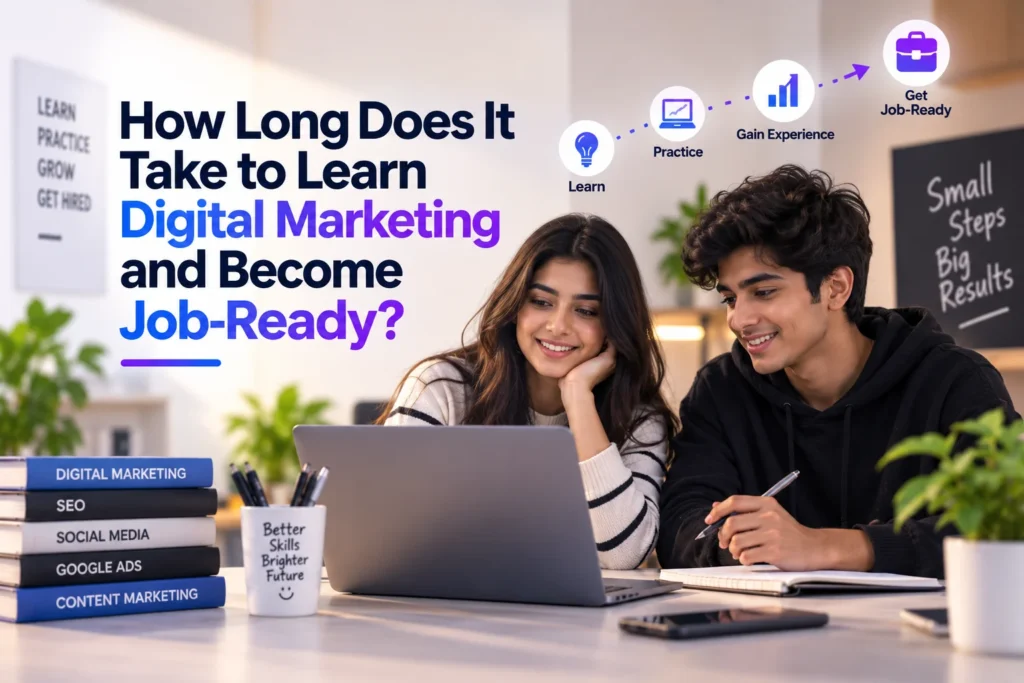
Digital marketing has become one of the most valuable skills for students, graduates, working professionals, and entrepreneurs. As businesses increasingly depend on Google, social media, websites, online advertising, and content to reach customers, the demand for people who understand digital marketing continues to grow.
For students and professionals in Panvel, learning digital marketing can open doors to careers in SEO, social media marketing, paid advertising, content marketing, email marketing, analytics, and more. This is one reason why the demand for a digital marketing course in Panvel has increased among people looking to develop practical, career-oriented skills.
Being job-ready doesn’t mean knowing every area of digital marketing.
It means having enough knowledge and practical experience to perform common marketing tasks independently.
A job-ready beginner should understand areas such as:
You should also be able to work on practical tasks such as:
1 Month: Understand the Fundamentals
During the first month, focus on understanding how digital marketing works.
You can learn:
At this stage, your goal should be understanding the marketing ecosystem, not becoming an expert in every tool.
2–3 Months: Build Practical Skills
After learning the basics, start working on practical projects.
You can focus on:
This is where digital marketing starts becoming easier to understand because you are applying what you have learned.
4–6 Months: Become Job-Ready
With consistent practice, many beginners can develop a solid foundation within four to six months.
At this stage, you should be able to work on complete projects.
For example:
SEO Project
Research keywords → Optimise pages → Create content → Build internal links → Monitor Google Search Console.
Social Media Project
Research audience → Create content strategy → Plan posts → Create Reels → Analyse engagement.
Google Ads Project
Research keywords → Create campaigns → Write ad copy → Set targeting → Monitor performance.
The exact timeline varies depending on your learning schedule and the complexity of the skills you want to develop.
One of the biggest mistakes beginners make is trying to learn everything simultaneously.
Instead, build your skills in stages.
Stage 1: Digital Marketing Fundamentals
Understand:
Stage 2: SEO
Learn:
Stage 3: Social Media Marketing
Learn:
Stage 4: Paid Advertising
Learn:
Stage 5: Analytics and AI
Learn:
This combination gives you a broader understanding of modern digital marketing.
Very important.
You can watch hundreds of digital marketing tutorials and still struggle with a real project if you haven’t actually implemented what you’ve learned.
For example, reading about SEO is different from optimising a real website.
Similarly, watching a social media marketing tutorial is different from creating and managing an actual content calendar.
This is why practical projects should be an important part of digital marketing courses.
Try working on:
The objective is to build evidence that you can actually apply your skills.
Explore industry-focused certification courses that combine practical training, AI-powered tools, live projects, and placement assistance to help you build a successful career in today’s digital world.
Master Digital Marketing Course in Kharghar with practical training and live projects.

Learn Amazon selling, product listing, PPC advertising, and marketplace business management professionally.

Master creative graphic designing using Photoshop, Illustrator, Canva, branding, and AI design tools.
Learn modern UI/UX design using Figma, prototyping, wireframing, and responsive design principles.
All courses are available at our Digital Marketing Institute in Kharghar, Navi Mumbai, with practical training, industry-recognized certifications, and placement assistance.
Before enrolling, check whether the course covers the skills you actually want to develop.
A good curriculum may include:
Also check whether students actually get opportunities to work on projects.
A certificate can show that you completed a course, but practical skills and project experience are what you need to demonstrate what you can do.
1. Don't Try to Learn Everything at Once
Start with the fundamentals and gradually expand your skills.
2. Practise Every Day
Even 60–90 minutes of practical work can make a significant difference when done consistently.
3. Build Your Own Project
Create a website or social media account and use it as your practice environment.
4. Learn Google Search Properly
Understanding search intent, keywords, SEO, Search Console, and content optimisation is valuable for many digital marketing roles.
5. Practise Social Media
Don’t just watch social media marketing tutorials.
Create actual posts, Reels, content calendars, and campaigns.
6. Learn Analytics
Marketing decisions should not be based entirely on assumptions.
Learn how to interpret:
7. Use AI as a Learning Assistant
AI tools can help you:
But don’t allow AI to do all the thinking for you.
Understanding why a marketing strategy works is more valuable than simply knowing which AI prompt to use.
There are no shortcuts that can replace learning and practice, but a few practical hacks can make the process more efficient.
Hack 1: Learn by Doing
Spend less time only watching tutorials and more time implementing what you learn.
Hack 2: Turn One Topic Into Multiple Skills
For example, choose one local business and practise:
SEO + Google Search + Social Media + Content + Analytics
This helps you understand how different channels work together.
Hack 3: Create a Portfolio While Learning
Don’t wait until you finish your course.
Start documenting your projects from the beginning.
Your portfolio could include:
Hack 4: Follow Industry Updates
Digital marketing changes quickly.
Follow updates about:
What you learn today may need to be updated later.
So, how long does it take to learn digital marketing and become job-ready?
For many beginners, 3–6 months of consistent learning and practical work can provide a strong foundation for entry-level digital marketing roles. However, becoming highly skilled is an ongoing process because search engines, social media platforms, advertising tools, and AI technologies continue to evolve.
If you are considering digital marketing courses in Panvel or Kharghar, don’t choose a course only based on duration or certification.
Look for a program that gives you:
Knowledge + Practical Projects + Tools + Portfolio + Industry Skills
The fastest way to learn digital marketing isn’t to find a shortcut.
It’s to learn, practise, measure, improve, and repeat.
That approach can help you move from a beginner to a confident digital marketing professional while building skills that remain useful as the industry changes.
360 Digital Marketing Institute is a leading Digital Marketing Institute in Kharghar, offering practical training in SEO, Google Ads, Social Media Marketing, AI Marketing, WordPress, Graphic Design, UI/UX Design, and Amazon eCommerce. Learn through live projects, industry certifications, and placement assistance.
© 2026 | 360 Digital Marketing Institute. | All Rights Reserved
Serving students from Kharghar, Panvel, Kamothe, Kalamboli, Belapur, Nerul, Vashi, Thane, Dombivli, Kalyan, Mulund, Ghatkopar, Kurla, Dadar, and nearby locations across Mumbai and Navi Mumbai.